





Introduction: The Collision of Luxury Craftsmanship and Clone Watches
Richard Mille Watches and an Overview of the Luxury Market
Richard Mille stands out as one of the leading names among high end luxury watch brands. When consumers ask, “why are luxury watches so expensive,” the answer often lies in meticulous craftsmanship, complex movements, and a rigorous selection of materials. As an exemplar of high end luxury watches, Richard Mille has become synonymous with innovative design—often described as the richard mille style watch—and is frequently cited as the maker of the most expensive watch richard mille. Their pricing model is transparent: every timepiece is crafted with precision to maintain its unique allure in the luxury market, effectively reinforcing the core value of genuine luxury watches. But at the same time, the global replica watch market is growing at an annual rate of 17.3% — more and more consumers are beginning to think: when the craftsmanship gap between authentic and replica watches narrows to the point where they are difficult to distinguish with the naked eye, do we still need to pay dozens of times more for the brand premium?
Ouswatch Super Clone Watches – A High Cost-Effective Alternative Choice
In contrast, Ouswatch offers super clone watches that provide a more affordable entry point without completely sacrificing design or quality. These watches are recognized among consumers as examples of cool affordable watches and have earned a reputation as some of the best affordable watch brands and best affordable wrist watch options. By carefully replicating key design elements of luxury models, Ouswatch delivers an attractive alternative for those curious about what makes a watch expensive without the associated high cost. Some market feedback even refers to them as bargain designer watches or the cheapest richard mille alternative, appealing to buyers who seek the look of high-end craftsmanship at a budget-friendly price.
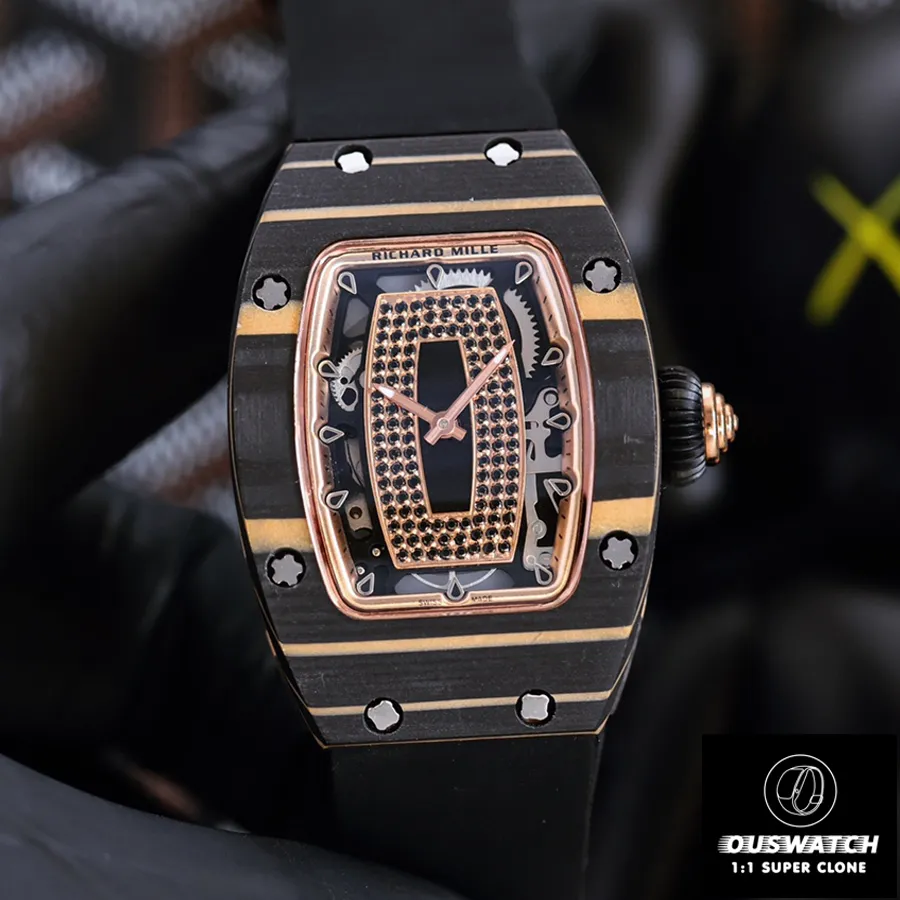 The Legendary Heritage of Richard Mille Watches
Brand Founding & Evolution
In 2001, while traditional Swiss watchmakers relied on centuries of heritage, Richard Mille emerged as a disruptor. The founder, Richard Mille—not from a watchmaking dynasty—leveraged his cross-industry expertise in precision engineering and luxury goods (having worked at French conglomerate Finhor and jewelry house Mauboussin) to propose a radical vision: integrating Formula 1 racing and aerospace technology into watch design. This unconventional approach directly addresses the question “why is Richard Mille so expensive”—from its inception, the brand rejected compromises in traditional craftsmanship, prioritizing extreme material innovation and technical investment.
For instance, the debut RM 001 Tourbillon took three years to develop, utilizing titanium and carbon fiber to achieve a mere 38-gram weight, with R&D costs exceeding millions of dollars. Mille famously stated: “If you can’t recognize a Richard Mille from five meters away, it’s a failed design.” This obsession with visual identity and functionality sparked immediate buzz among elite collectors.
Notably, when consumers search “how much is a Richard Mille watch,” answers range from $100,000 to over $2 million. This vast price spectrum reflects the brand’s mastery of niche markets: entry-level models cater to budding collectors, while diamond-encrusted or limited editions target ultra-high-net-worth individuals.
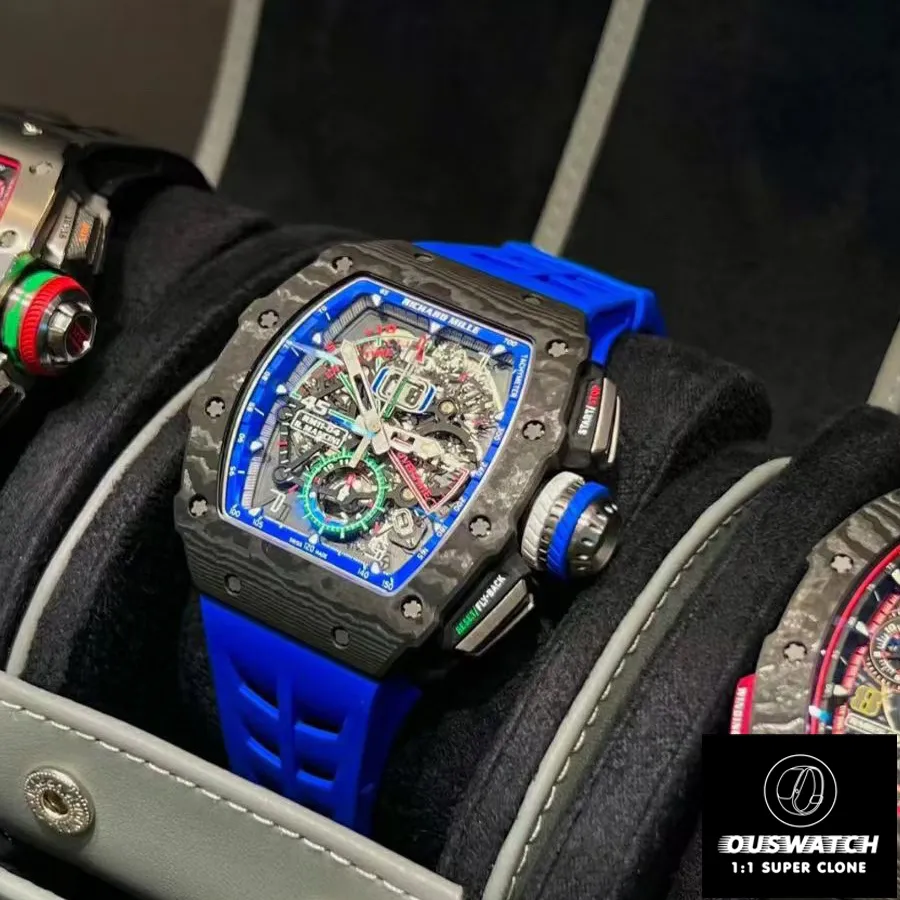 Richard Mille’s Positioning in the Luxury Market
Within the realm of “high end luxury watch brands,” Richard Mille deliberately avoids competing with Patek Philippe or Vacheron Constantin on historical prestige, instead carving out a “futuristic tech-luxury” niche. Its strategy hinges on three pillars:
Material Innovation Redefines Value
From graphene to ceramic alloys, the brand has invested over $120 million in developing composite materials. The RM 56 Sapphire Tourbillon, for example, requires 1,000 hours of precision cutting for its case, with a yield rate below 30%. This cost-no-object production philosophy answers “what makes a watch expensive”—each timepiece essentially functions as a micromechanical engineering prototype.
Strategic Partnerships Amplify Exclusivity
Collaborations with F1 drivers, tennis stars (like Rafael Nadal), and America’s Cup teams transform “extreme-environment reliability” into tangible proof. When Nadal wore the RM 027 during matches, the watch endured 5000G shocks—real-world validation that justifies the “cost of Richard Mille watches” more powerfully than any marketing claim.
Scarcity Through Controlled Production
Despite soaring demand, annual output remains capped at 5,000 units. Contrasting Rolex’s 1 million+ yearly production, Richard Mille sustains premium pricing through artificial scarcity. As noted by Geneva watch auction experts: “Secondary market prices often exceed retail, given lower circulation volumes than even independent watchmakers.
Why Are Richard Mille Watches So Expensive?
Top-Tier Craftsmanship and Technical Innovation
To answer “why are Richard Mille watches so expensive,” one must first examine the engineering complexity of its movements. A single Richard Mille caliber may contain over 600 components, many of which require months of hand-finishing. For example, the RM 74-01 automatic tourbillon features a 5Hz high-frequency balance wheel—extremely rare in mechanical watches—to achieve quartz-level precision. Developing such innovative technology is not only time-consuming but also extraordinarily costly. Industry insiders estimate that prototyping a new Richard Mille movement can cost between $2 million and $4 million, directly addressing the question “how much does it cost to make a Richard Mille.”
This relentless pursuit of technical limits is the ultimate answer to “what makes a watch expensive.” Take the RM 27-05 Rafael Nadal edition, designed specifically for tennis: it withstands accelerations of 12,000G. Over 80 prototype watches were destroyed during testing—a process comparable to crash tests in Formula 1. As one watchmaker put it: “Building a Richard Mille is not watchmaking—it’s microscopic architecture under pressure.”
Extreme Material Pursuit
Material science is a key battleground where Richard Mille redefines “what makes a watch expensive.” The brand invests 18–24 months of R&D for each type of composite:
- TitaCarb®: A carbon fiber-reinforced titanium alloy, costing up to $12,000/kg, used in the RM 11-05 flyback chronograph
- Graph TPT®: A quartz composite infused with graphene, requiring 28 days of layered compression molding
- Transparent Ceratanium®: A ceramic-titanium hybrid with a sintering failure rate of up to 60%
Even the “simplest” components defy convention. The sapphire crystal case of the RM 56-02 requires 1,150 hours of CNC machining, with 7 out of every 10 prototypes scrapped due to microfractures. This material waste alone adds over $85,000 to the production cost of each piece.
Design Philosophy and Limited Production
When collectors ask “why is Richard Mille so expensive,” the answer lies in its deliberately engineered scarcity. Hyper-limited models like the RM 69 Erotic Tourbillon are produced in runs of only 12–18 pieces per year. Custom orders require a 2–3 year wait, with clients paying over $300,000 just for the privilege of personalizing details such as rotor engravings.
This man-made scarcity forms a self-sustaining price loop. The RM 52-06 Pharrell Williams limited edition (30 pieces) sold out within hours, while the RM 011 appreciates at an annual rate of 8–12% on the secondary market. In contrast, mass-produced luxury watches often depreciate 20–30% post-purchase.
Added Value and Brand Premium
The “cost of Richard Mille watches” goes far beyond parts and labor—it’s about cultural symbolism. Three core strategies build this brand premium:
- Celebrity Endorsement Matrix: Collaborations with athletes like golfer Bubba Watson and F1 driver Charles Leclerc generate over $18 million in annual media value
- Technical Storytelling: Each watch is an engineering legend, such as the RM 27-04 with a carbon nanotube baseplate (stronger than steel, six times lighter)
- Auction Performance: The RM 56-01 prototype sold for $2.5 million at a Geneva auction—three times its retail price
Best Richard Milles Recommendations
RM 56-02 Sapphire Tourbillon
As the pinnacle of a “Richard Mille style watch,” the RM 56-02 Sapphire Tourbillon redefines what’s possible in luxury timepieces through transparent aesthetics and engineering marvel. The case of this model is crafted from three solid blocks of sapphire crystal, each requiring 960 hours (approximately 40 days) of machining, with a yield rate of less than 30%—7 out of 10 prototypes are scrapped due to microscopic cracks, resulting in over $85,000 in material waste alone.
Its revolutionary innovation lies in the “suspended movement” design: a titanium baseplate is suspended within the case by a 0.35mm braided steel cable system and ten pulleys, equipped with a tension indicator to ensure mechanical stability under extreme conditions. This technique originates from the RM 27 series developed with tennis legend Rafael Nadal, but the application of sapphire material significantly raises the level of difficulty—sapphire components such as the barrel bridge and tourbillon frame require an additional 400 hours of precision polishing.
Limited to 10 pieces and priced at $2.02 million each, the RM 56-02 reflects not only the 1,500 total hours of production time but also the brand philosophy that “technology is art.”
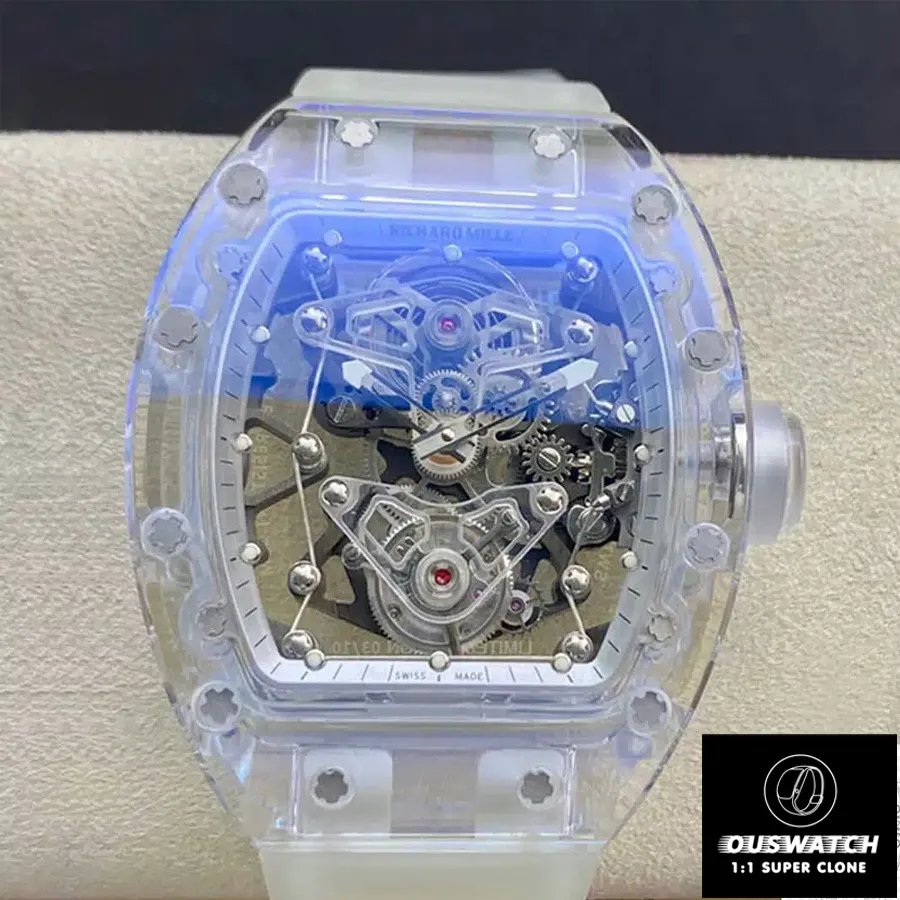 RM 11-03 Mclaren Flyback Chronograph
The RM 11-03 Automatic Flyback Chronograph is one of the most definitive answers to “how much is a Richard Mille watch,” with a price range between $250,000 and $500,000 depending on the materials and limited edition variations. This model continues the brand’s signature tonneau-shaped case design, but distinguishes itself through material innovation: for example, the use of titanium and carbon composite case (TitaCarb®), offering both lightness (total weight under 100 grams) and impact resistance.
“What makes a watch expensive” is embodied here through the integration of three complex functions—flyback chronograph, annual calendar, and UTC time zone switching. The RMAC3 movement contains 54 jewel bearings and a double-clutch system, capable of withstanding shocks up to 5,000G, surpassing even some racing instrument standards.
The deep integration with motorsport (such as partnerships with the McLaren team) further reinforces its premium positioning: each RM 11-03 is not merely a timing instrument, but a symbol of engineering culture.
 RM 35-02 Richard Mille Rafael Nadal Black
As a strong contender for the title of “most expensive watch Richard Mille,” the RM 35-02 Rafael Nadal is renowned for its lightweight build and shock resistance. The case is made from the brand’s patented Graph TPT® graphene composite, weighing only 32 grams while withstanding acceleration forces up to 12,000G—comparable to the pressure experienced during a spacecraft’s reentry into the atmosphere.
Its core cost lies in miniaturization technology: the tourbillon cage measures just 0.27 mm thick—thinner than a human hair; the movement baseplate is reinforced with carbon nanotube material, with over $8 million invested in R&D.
The limited run of 50 pieces transforms rarity into pricing power. Data from the secondary market shows this model appreciates at an average annual rate of 15%, far exceeding the value retention of traditional luxury watches. When exploring “how much does it cost to make a Richard Mille,” the RM 35-02’s production cost accounts for approximately 60% of its retail price—well above the industry average of 30%.
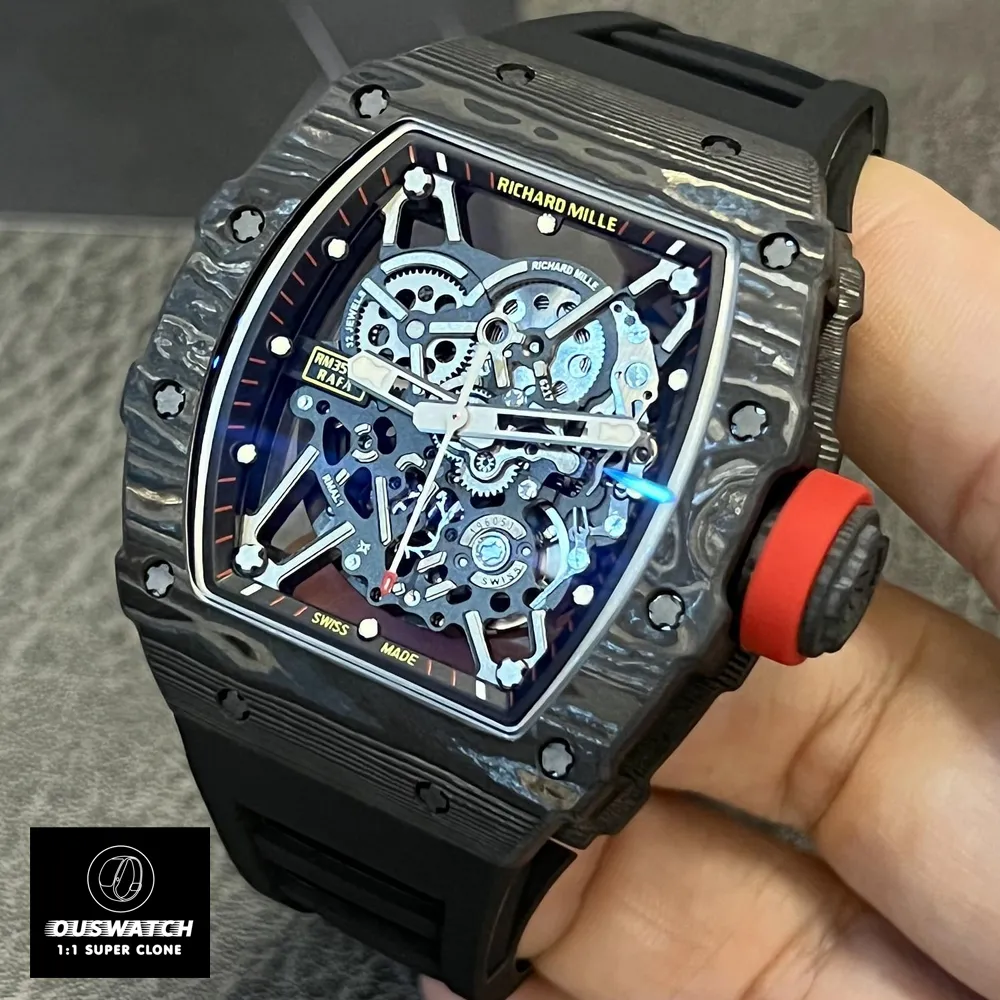 Super clone watches: the best alternative to the high-priced Richard Mille
Market Positioning of High-Quality Super-Clone Watches
Under the consumer trends of “cool affordable watches” and “best affordable watch brands,” super clone watches are emerging as a “light luxury alternative.” These products faithfully replicate the design language of genuine timepieces—such as Richard Mille’s signature tonneau-shaped case or tourbillon structure—while adopting cost-optimized production methods. For example, 316L stainless steel is used instead of titanium alloy, and custom movements replace factory-original complex modules, allowing prices to remain within 1%–5% of the original. Take the example of Factory N: its replica of the Blancpain Fifty Fathoms series features a sapphire bezel similar to the original, yet mass production brings the cost down to the 2,000 RMB range, meeting the demand for a “million-yuan-level design at a thousand-yuan budget.”
The core logic of this positioning lies in stripping away brand premiums while retaining the essence of visual and functional experience. Just like the high-value picks often found on “best affordable wrist watch” rankings—such as the Timex Q GMT or Casio G-Shock—super clone watches also focus on the “core experience,” including accurate timekeeping, water resistance, and recognizable design, rather than pursuing a strict material or craftsmanship match.
Design Philosophy of Ouswatch Richard Mille Super Clone Watches
When discussing “fake Richard Mille vs real,” Ouswatch’s approach is: micro-level replication and macro-level innovation. Taking the RM 011 replica as an example, the case lines and chronograph pusher angles are controlled within a 0.1mm margin of error compared to the original, even replicating Richard Mille’s signature “recognizable from five meters away” principle.